A Day of October Bass Fishing on the Shubenacadie River
Shubenacadie River, Nova Scotia | October | Smallmouth Bass | River Fishing | Tidal Waters
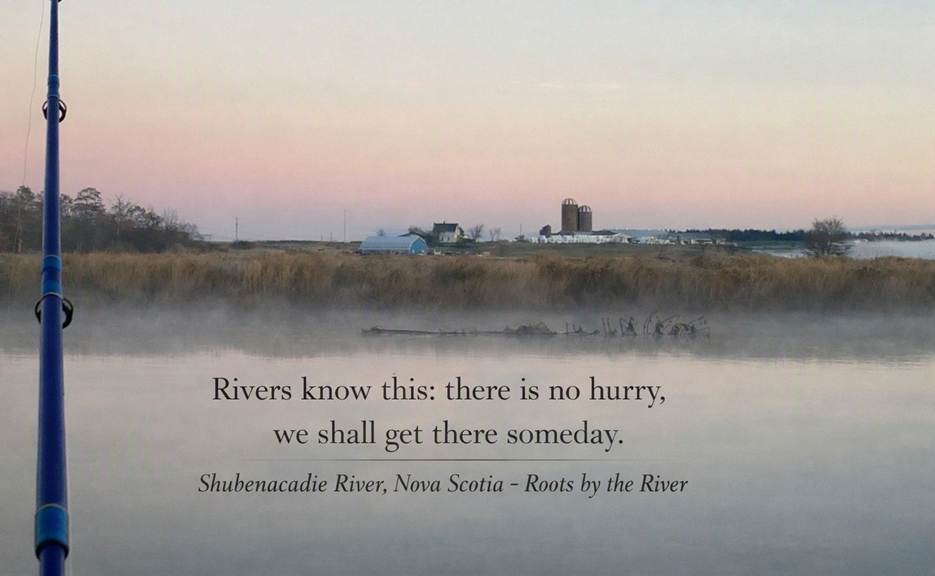
The Shubenacadie river landscape in October — where river, tide, and forest converge.
The River Before the World Wakes Up
The bow of the canoe touches the Shubenacadie just as the sky shifts from ink to pewter. It is mid-October, and the air carries the kind of cold that is not yet winter but is no longer apologizing for anything — a sharp, honest cold that settles into the lungs and makes every breath feel deliberate. The water is the colour of dark tea, smooth and heavy, and a low mist hangs over the surface in thin veils that the stillness refuses to disturb.
You push off from the bank and the current takes you immediately — even here, even at this hour, the river has an opinion. Somewhere ahead, buried in the alders along the far bank, a belted kingfisher announces the day with its rattling, indignant call, then arrows downstream and disappears around the bend. It is the only sound in the world.
The maples on the hillside above the river are incandescent. Gold, copper, deep arterial red — colours that have no business being this vivid in the half-light, and yet here they are, blazing. A great blue heron stands motionless on a gravel bar exposed by the retreating tide, patient as stone, watching the water with the concentrated stillness of something that has been doing this for a very long time. The Bay of Fundy is sixty kilometres south of here, but its influence is everywhere — in the chocolate-coloured tideline on the clay banks, in the exposed mudflats on either side of the channel, in the faint smell of brine and cold earth that rides the air on still mornings.
There is a particular kind of excitement that comes with being on a river like this in October. It is not the feverish excitement of summer, of fast topwater strikes and fish everywhere and long warm evenings. It is quieter than that. More purposeful. It carries with it an awareness that the window is closing — that the river, the fish, and the season are all in the process of becoming something else. You want to be here. You want to read every eddy, every current seam, every clay bank drop-off with care, because the fish that will eat today will eat with the economy and precision of creatures preparing for a long winter. That focus makes you sharper. It always does.
The River in October — Character and Personality
The Shubenacadie is not a pretty river in the conventional sense. It is not clear and mountain-fed, tumbling over granite and gleaming in the sun. It is wide, brown, tidal, and fundamentally moody — a river that changes its face several times each day and asks you to pay attention. The famous chocolate colour comes from the clay soils of the surrounding landscape, soils that have been eroding into this watershed for millennia, giving the water a turbidity that filters light and hides structure below the surface. You learn to fish it by feel and by knowledge rather than by sight.
At low tide, the river narrows to a winding channel between broad mudflats — grey, glistening plains that attract shorebirds and herons and look from a distance almost lunar. Submerged log jams that disappear entirely at high water reappear at the ebb as dark, barnacled obstacles rising from the mud. The river at high tide is a different creature entirely: wider, deeper, more serene, the banks full and the current slower. You could fish the same stretch in the morning and again in the afternoon and feel as though you were on a different river.
In October, the fall colours along the banks reach their peak in the first two weeks of the month. The reflections in the slack-water bends — birch and maple mirrored in the dark current — are extraordinary. There are moments, paddling through a gentle arc of river with the colours above and below you and nothing else moving, when you want to put the rod down and just sit.
| ⓘ Did You Know? — The World’s Highest Tides The Bay of Fundy has the highest tides in the world, with a tidal range of up to 16 metres in some locations — enough to swallow a five-storey building twice daily. The Shubenacadie River is directly influenced by these tides, which push upstream with enormous force, raising river levels dramatically, submerging structure, and then retreating to expose vast mudflats within a matter of hours. This makes the Shubenacadie one of the most dynamic and demanding freshwater fisheries in Atlantic Canada. |
Why October Is Special for Bass
The October Feed Bag
Ask any serious smallmouth angler about their best fish, and more often than not, it came in late September or October. There is a reason for that. As water temperatures drop through the 10–15°C range, smallmouth bass enter what experienced anglers often call the “feed bag” — an aggressive, sustained period of caloric loading as the fish prepare for the metabolic slowdown of winter. The bass that were scattered across the river all summer, chasing baitfish near the surface and holding in the shade of undercut banks in the heat, begin to consolidate. They move toward transitional depth, concentrate near reliable food sources, and begin feeding with a focus that is distinctly different from summer opportunism.
In a tidal river, this behaviour is layered with additional complexity. Unlike lake bass, which simply respond to water temperature and light levels, river smallmouth must also account for current direction, velocity, and tidal stage. A fish that is actively feeding on an incoming tide may be completely inactive an hour later when the current reverses. Understanding tide and temperature together is the core skill of fishing the Shubenacadie in October.
October also tends to produce the largest smallmouth of the year. The biggest, wariest fish — the ones that avoid pressure and maintain large territories — are the most motivated feeders as winter approaches. A four- or five-pound Shubenacadie smallmouth taken in October on a slow-dragged tube bait is a fish that has earned every one of its years.
Reading the Water Temperature
Carry a thermometer. This is not optional advice — it is the single most important piece of information you will collect on an October outing. The 10°C threshold is critical. Above it, smallmouth remain reasonably active and will chase presentations across moderate distances. Below it, the fish become lethargic; their metabolism slows, they conserve energy, and they will rarely move far for a meal. Presentations must slow down accordingly, and you must bring the bait to the fish rather than expecting the fish to come to the bait.
The best fishing on the Shubenacadie in October typically occurs during the midday warming window — roughly 10 a.m. to 3 p.m. — when the sun has had time to add a degree or two to the surface layer and the fish are at their most willing. Early mornings are slower than in summer. Plan your most precise, technical fishing for mid-morning through early afternoon, and use the early hours to cover water, scout structure, and get a feel for which tide stage you are entering.
Understanding Tides on the Shubenacadie
The Tide as Your Co-Pilot
If you have only fished still-water bass, the tidal element of the Shubenacadie will require an adjustment in thinking. The incoming tide does not merely raise the water level — it actively pushes upstream, creating a slow but powerful current running counter to the river’s natural flow. Structure that sits in the middle of the channel at low tide may be completely submerged and invisible at high water. Gravel bars that were productive ambush points for bass in the morning may be under two metres of water by noon. The fish move with the water, and you must move with the fish.
One of the most dramatic expressions of Fundy’s power on this river is the tidal bore — a visible wave, sometimes just a few centimetres high in the upper reaches and much larger closer to the Bay, that travels upriver as the tide turns from ebb to flood. It arrives as a subtle rolling wave, curling around the bends, pushing ahead of the incoming tide. After the bore passes, the water rises quickly. Current seams that existed moments before dissolve. New ones form. The fish respond immediately. Bass that were staged in current-break ambush positions often shift as the bore arrives, moving to new structure as the water reorganizes around them. Knowing when the bore will arrive — and being positioned correctly before it does — is one of the great tactical challenges of this fishery.
Best Tide Windows for Bass
Through experience on this system, three tide windows stand out as consistently productive:
- The last two hours of the incoming tide: Current slows, the water is at or near full, and bass move shallow to feed along submerged structure. Tube baits and finesse jigs worked slowly through submerged log jams and clay bank edges can be excellent.
- Slack water: A brief but productive window — often just 20 to 40 minutes — when current is minimal. Bass are exposed from their current-break positions and may roam more freely. Covering water with a small crankbait or swimjig can be effective during this window.
- The first two hours of the outgoing tide: As the river begins to drop, current increases, and bass stack on the downstream edges of structure — the lee side of log jams, the tail end of gravel bars, the inside bends of clay banks — waiting for baitfish and crayfish to be swept past in the current. This is often the most consistent and reliable window for numbers of fish.
| ✓ Pro Tip — Check Tides First Before any trip to the Shubenacadie, consult a tide chart specific to this river system. The Nova Scotia government and several marine weather applications provide local tide predictions referenced to stations along the Fundy coast. Plan to fish the incoming-to-slack transition and the first two hours of the outgoing tide for best results. Tides run approximately 50 minutes later each day — what was the perfect morning window today will be a midday window tomorrow. Build your schedule around the tide, not around habit. |
A Morning on the Water
By eight o’clock, the mist has begun to lift in slow, rising columns where the sun finds the water between the trees. I have anchored the canoe off a clay bank on the inside of a long bend, maybe thirty metres from a submerged rock pile that I know is there but cannot see — the incoming tide has swallowed it completely. I know the rocks are there because I have been here before, on lower water, and I have catalogued it. That knowledge is worth more than any piece of tackle.
The first cast drops a pumpkin/green-flake tube bait just past where the rocks should be. I let it sink on a semi-slack line, feeling for the moment the weight touches bottom through six feet of chocolate water. Then I begin to move it — not a retrieve, really. More of a negotiation. A pull, a pause, a drag, another pause. Cold-water bass want the meal delivered. They do not want to run for it.
The hit, when it comes, is a sharp rap — not the soft mushing pick-up of a warm-water bass inhaling a bait with casual confidence, but a definite, aggressive knock. I set the hook with a sideways sweep and the rod loads heavily. Immediately: that bulldogging, head-down pull that tells you smallmouth before you ever see the fish. A river fish in current doubles the fight — it uses the water against you, turning sideways to catch the flow, surging downstream in short, powerful runs.
When she finally rolls beside the canoe, she is everything October promises — deep olive and bronze along the flank, the lateral line a dark seam of amber, the belly the colour of old ivory. Three pounds, maybe three and a quarter. She has been eating well. The hook slides free easily, and she is gone before I have fully registered the moment — a flash of bronze into the dark water, back into the river she belongs to.
I sit for a moment and listen. Somewhere upriver, around the bend I cannot see, the sound of the water has changed. A low, continuous murmur that wasn’t there a minute ago. The tidal bore, arriving on schedule, carrying with it the full weight of the Bay of Fundy.
Structure and Habitat — Where October Bass Live
Where October Bass Live
The Shubenacadie is rich with structure, and learning to read it — in water that hides almost everything — is what separates a productive day from a frustrating one. In October, bass relate to structure differently than they did in July. The “depth refuge” principle is key: as water temperatures fall, bass use deeper water as a thermal buffer, retreating to holes of 8 to 14 feet between feeding periods and making excursions to shallower structure during the active windows around the best tide stages and midday warmth.
Key structure types to target on the Shubenacadie in fall:
- Submerged log jams and rootwads: The most reliable ambush structure on the river. Bass stack tight to these features, using them to break current and wait for food. Fish the downstream face on the outgoing tide; fish the upstream face on the incoming.
- Clay bank drop-offs: The outside of every bend has a vertical clay wall dropping into deeper water. Bass cruise these edges, especially where a seam forms between the deep water and slower water near the bank.
- Gravel bars: The downstream end of every gravel bar is a natural funnel. Baitfish get pushed over the bar by current and swept into the deeper water beyond. Bass wait below.
- Current seams: The line between fast water and slow water is where bass ambush passing forage with minimum energy expenditure. These seams shift dramatically with the tide — mark them and follow them.
- Deep holes: The thermal refuges. In the coldest October conditions, bass hold here between feeding periods. Vertical presentations — blade baits, jigging spoons — come into their own in these spots.
Following the Forage
In October on a river like the Shubenacadie, the bass forage menu narrows and simplifies. Crayfish become the primary food source. Cold water slows the crayfish’s reflexes, making them easier to catch and more predictable in their movement. They cling to the rocky and clay bottoms, and the bass know exactly where to find them. Matching the crayfish — in size, colour, and movement — is the single most important tactical decision you will make on an October day.
Juvenile perch and shiners remain a secondary forage option, particularly during active tide windows when current concentrates small baitfish at current seams and the tails of gravel bars. An early-October morning might occasionally still find a bass willing to eat a small frog along the margins, but by mid-October this is rare — the frogs are gone, the water is cold, and the bass have adjusted their expectations accordingly.
In the stained water of the Shubenacadie, presentation colour matters more than usual. Natural crayfish colours — orange-brown, pumpkin, olive-green — are nearly always more effective than bright or chartreuse tones. The fish are hunting by lateral line and scent as much as by sight in this visibility. Give them something that looks and moves like the real thing.
Bait and Tackle for October River Smallmouth
Top Baits for October River Smallmouth
The October Shubenacadie rewards restraint and precision. This is not a time for high-speed retrieves or aggressive reaction baits (with a few notable exceptions). The fish are there — often in good numbers — but they want the meal served slowly and convincingly.
| Bait | Size / Weight | Best Colours | Technique |
| Tube Bait | 2.5″–3.5″ / 1/8–1/4 oz head | Pumpkin/green flake, brown/orange, natural craw | Drag slowly along bottom; long pauses; let it sit in current breaks |
| Hair Jig / Marabou Jig | 1/8–3/8 oz | Brown, black, olive | Slow pendulum swing through current seams; subtle lift-and-drop |
| Finesse Jig with Craw Trailer | 3/16–5/16 oz | Natural brown/green, watermelon | Creep along clay bank edges and through rocky structure |
| Shaky Head / Drop Shot | 1/8–3/16 oz / 4″ finesse worm | Green pumpkin, smoke, natural | For pressured or deep fish; minimal movement; let the current do the work |
| Small Suspending Crankbait | 5–7 cm | Natural shad, brown/craw, perch | Slow roll with long pauses along clay banks and over log jams |
| Blade Bait / Jigging Spoon | 1/4–1/2 oz | Hammered gold, silver, natural shad | Vertical jigging in deep holes; bottom contact; when water is below 10°C |
| The tube bait is the October smallmouth lure. If you fish nothing else on a tidal river in fall, fish a tube — dragged slowly, patiently, convincingly along the bottom. It looks like a crayfish. It moves like a crayfish. And cold-water bass, who have been watching crayfish all summer, are not easily fooled by anything less. |
Rod, Reel, and Line Setup
In cold water, sensitivity is everything. Bites are subtle — a slight additional weight, a soft tick, a line that goes from bow to slack without any obvious thump. You need to feel those signals clearly.
- Rod: A 7-foot medium-light to medium spinning rod with a fast tip. The fast tip telegraphs subtle bites; the medium backbone handles the fight in current. For heavier jigs along deep banks, a 7-foot medium baitcaster performs exceptionally well.
- Reel: A quality spinning reel in the 2500–3000 size range for finesse work. Smooth drag is critical — cold-water smallmouth can make surprising runs on light line.
- Main Line: 10–15 lb braided line. Braid’s near-zero stretch transmits every sensation from the bottom directly to your hands. In cold water, that zero-stretch advantage is amplified — you will feel bites you would miss entirely on monofilament.
- Leader: 8–10 lb fluorocarbon leader, 18–24 inches. Fluorocarbon is virtually invisible underwater, is stiffer than monofilament (better lure action in cold water), and provides superior abrasion resistance around the rocky and root-laden structure of the Shubenacadie. In stained water, the low visibility of fluorocarbon matters less than in clear systems — but the sensitivity and abrasion benefits remain.
Afternoon Light
By early afternoon, the tide has turned in earnest. The river is dropping — you can see it in the clay banks, the widening dark band of exposed mud above the waterline, the gravel bar downstream that has grown from a thin strip to a wide, pale crescent. The current has picked up again, running now in its natural direction with quiet authority.
I pole quietly along the downstream edge of the gravel bar, watching the seam where fast current meets the slacker water in the bar’s shadow. The hair jig goes in at the upstream end of the seam and drifts naturally, ticking along the bottom. The first take is decisive — a short, hard grab — and the fish is on, spinning sideways in the current before I can get my rod angle right. She comes to hand quickly: a solid pound and a half, perfect and healthy, a fish feeding exactly where the river told me it would be.
Two more fish from nearly the same spot over the next twenty minutes. The ambush point was giving up its secret freely, and then, as suddenly as it began, it went quiet. The seam had shifted slightly as the river dropped further. I moved ten metres downstream to where the new seam had formed. Nothing. Then another cast, another drift. Another fish.
The afternoon sun breaks through a bank of cloud to the southwest and for a few minutes the river is transformed. The maples on the far bank are incandescent amber, and their reflection in the slack water behind the bar creates a mirror image so perfect and still that the world seems doubled, the river holding the sky and the trees and the late October light in one shimmering, motionless frame. A pair of buffleheads — the first of the season — drift past in the current, small and dapper and entirely unbothered. I watch them go.
This is what the Shubenacadie gives you in October: the fish, yes, but more than that. The feeling of having read a living, breathing, tidal river correctly — of having made good decisions, been in the right place, and earned the result. That satisfaction does not diminish with repetition. If anything, it deepens.
Safety on the Shubenacadie — Know Before You Launch
Respect the Tides — They Can Be Dangerous
The Shubenacadie River is not a gentle fishery. Its beauty and productivity come directly from the same tidal forces that make it genuinely dangerous to the unprepared. These points are not suggestions.
- Always wear a PFD. Always. In a river subject to sudden current reversals, bore waves, and rapidly rising water, a personal flotation device is not optional equipment. Wear it from launch to takeout.
- Know your tide times before you launch. The tidal bore arrives on a predictable schedule, but that schedule changes daily. Know when it is coming, where you will be when it arrives, and what your plan is. Do not be caught wading or on a mudflat when the bore turns the corner.
- Never wade on mudflats near the tidal bore. The clay-silt mudflats of the Shubenacadie can be deceptively soft — what appears to be firm ground can behave like wet concrete, trapping a foot or leg. Combined with rapidly rising water, this is a life-threatening situation.
- File a float plan. Tell someone exactly where you are launching, where you plan to take out, and when you expect to be off the water. Carry a charged mobile phone in a waterproof case.
- Carry a throw rope. Standard safety equipment for any moving-water paddling situation.
- Beware of tidal current transitions. The current velocity during the shift from incoming to outgoing can be significant. A canoe broadside to a strong tidal current is an unstable vessel.
Cold Water Safety
In mid-October, the Shubenacadie River water temperature typically ranges between 8°C and 12°C. Immersion in water this cold causes rapid cold shock — an involuntary gasping reflex, hyperventilation, and loss of swimming ability within minutes. Even a strong swimmer can drown in cold water before hypothermia sets in, simply because the initial shock overwhelms their ability to control breathing.
Dress for immersion, not for air temperature. The air may feel manageable in a fleece jacket, but if you go in the water, that jacket provides almost no thermal protection. Paddlers should strongly consider a dry suit or a wetsuit as the water temperature falls below 10°C. For bank anglers and those fishing from a jon boat, layered moisture-wicking base layers topped with a water-resistant outer layer and a PFD with built-in insulation provide reasonable protection and vastly improve your survival odds if something goes wrong.
| ⚠ Cold Water Warning — Dress for the Water Temperature At 10°C, you may have as little as one to three minutes of useful swimming ability after an unexpected capsize before cold shock impairs your coordination. A PFD keeps you at the surface when your muscles can no longer do so. Wear it. Always fish with a partner when possible, and never paddle alone on tidal water in October. |
The Drive Home
The boat is back on the trailer by quarter past five. The light is going fast — the way it does in October in Nova Scotia, with a kind of authority that reminds you the season is not negotiating. My fingers are numb at the tips from ungloved handling of fish and cold metal, and I am slow with the tie-downs, working by feel more than by sight.
Above the valley, on the ridge where the hardwoods meet the spruce line, the last light of the day is painting the crowns of the maples in shades of rose and deep amber — colours so warm against the darkening sky that they seem almost to generate their own heat. I stand at the truck for longer than necessary, watching it happen.
The gear in the hull smells of river mud and cold water and the particular mineral scent of clay bank — a smell that is, to anyone who has spent a season on this river, indistinguishable from the feeling of a day well spent. The rods are racked, the paddle wiped down, the tackle box re-sorted in that half-efficient, half-meditative way of the end of a fishing day.
October bass fishing has a specific weight to it that other seasons do not carry. There is the beauty — this river, these colours, this light — but there is also an urgency beneath the beauty that makes the whole day feel more alive than it might otherwise. The window is closing. The water will cross the 10°C line in the next few weeks and stay there. The bass will drop into their deep-water winter hold and stay close to the bottom until spring convinces them otherwise. The river will ice in the backwaters, the maples will go bare, the gravel bars will sit under grey November sky.
But that is not today. Today the river gave, and I received, and a handful of bronze fish flickered back into the dark current they came from, unbothered and intact. The season will freeze the clock for no one. But for one October day on the Shubenacadie, time moved at exactly the right pace.
| ★ Important Notice — Nova Scotia Angling Regulations: Know Before You Go Before heading out to the Shubenacadie River or any Nova Scotia waterway, anglers are required to be familiar with and comply with the current Nova Scotia freshwater fishing regulations. These include valid angling licence requirements, species-specific season dates, size and bag limits for smallmouth bass, and any special management area rules that may apply to specific reaches of the Shubenacadie River system. Regulations can and do change annually. Always consult the most current Nova Scotia Angling Regulations Summary, available through the Nova Scotia Department of Natural Resources and Renewables website or through licensed tackle dealers across the province. Fishing responsibly means knowing the rules — for the fish, for the fishery, and for every angler who comes after you. When in doubt, check the current regulations before you wet a line. |


Leave a Reply